 ube
ube
 JYU
JYU
 UL
UL
 JGU
JGU
 UO
UO
 UniPa
UniPa
 UV
UV
 UiA
UiA
 ULBS
ULBS
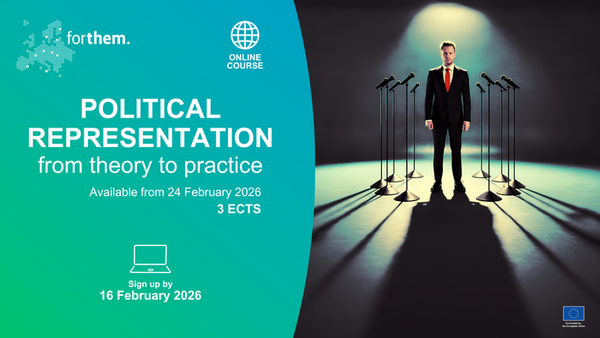
Political Representation: From Theory to Practice
Activity Type: Synchronous Course
Knowledge Category: Social Sciences, Journalism And Information
Language(s): English
Subtitles Language(s): ---
Estimated Workload (hours): 32
Max. Participants: 30
Teacher(s): Ieva Hofmane
Start Date: 23/02/26 23:00
End Date: 29/04/26 23:00
Enrollment Method: Open
Have you ever wondered why some voices in politics are heard more than others? This course invites you to explore how representative democracies function by examining the mechanisms behind political representation.
Instead of relying on traditional lectures, you will learn through a problem-based format. Each week, you will tackle a realistic challenge - framed as if you were advising a ministry, NGO, party, or local authority - and develop a defensible, evidence-based solution. Your task is to diagnose the problem, use course concepts to make sense of it, and develop an evidence-based response.
These challenges don’t have one “right” answer. What matters is how you think: the reasoning you use, the trade-offs you consider, and how clearly you can defend your solution. If you prefer a passive learning approach, this may not be the right format for you. But if you like learning by doing, you’ll likely enjoy it.
Across eight modules, you’ll apply key theories of representation to elections, political parties, social movements, and tools for evaluating the quality of representation. By the end, you won’t just know the theories - you’ll be able to use them to understand who gets represented, why it happens, and what could be done differently.
Lecture Schedule: An introductory session will take place on 24 February 2026, from 15:00–16:30 CET / 16:00–17:30 EET. After that, students will receive a new challenge and the corresponding materials each Tuesday. Weekly submissions are due each Friday by 23:59 EET, and students will receive feedback in the first half of the following week. If you need support at any point, you’re welcome to book a 1:1 video chat with the lecturer for questions or guidance.
This 3 ECTS synchronous course will be delivered entirely online (materials available in the FORTHEM Digital academy and an introductory live session in Teams).
Note: Only students who have pre-registered may participate in the course.